Topic. 10: Cryptocurrencies derivatives

Сайт: Навчально-інформаційний портал НУБіП України
Курс: International Exchange Activities ☑️
Книга: Topic. 10: Cryptocurrencies derivatives
Надруковано: Гість-користувач
Дата: вівторок, 9 грудня 2025, 08:20

1. History of cryptocurrency

Cryptocurrency is an innovative instrument or digital or virtual currency that uses cryptography for security, making it difficult to counterfeit. Cryptocurrencies are decentralized and are developed based on blockchain technology.
The concept of digital currencies dates back to the 1980s, when early pioneers in the industry, such as David Chaum, introduced secure electronic cash systems such as eCash.
The modern era of cryptocurrencies began with the launch of the now-famous Bitcoin, which was launched in 2009. As of 2023, there were about 19 million Bitcoins in circulation.
Bitcoin is officially attributed to its first mention in 2008 by Satoshi Nakamoto. A white paper titled “Bitcoin Peer-to-Peer Electronic Cash System” details the concept of a decentralized digital currency that can be sent from one participant to another without the need for an intermediary.
Starting in January 2009, Satoshi Nakamoto mined the first Bitcoin blockchain, the Genesis Block. This is considered the first beginning of the existence of the world’s most famous cryptocurrency and one of the most expensive.
After the successful use of Bitcoin, several other cryptocurrencies or altcoins emerged. Litecoin, which was launched in 2011, was one of the first altcoins. It was followed by others, such as Ripple (now XRP) and Ethereum. These altcoins aim to improve upon blockchain technology by offering faster transaction speeds, enhanced security features, and different consensus mechanisms.
ISO coins were subsequently proposed, with their popularity particularly notable in 2016 and 2018, allowing a large number of startups to raise funds through the issuance of their own tokens. Although many ISOs were legal, the lack of regulation led to numerous scams, which severely tarnished Bitcoin’s reputation.
As cryptocurrencies gained popularity, regulators around the world began to study their impact on financial markets and their stability, consumer protection, and the prevention of money laundering. Regulatory approaches varied, including different directions in each country:
- amending and implementing regulations on cryptocurrency trading;
- banning cryptocurrencies;
- partially restricting the use of cryptocurrencies.

2. Derivatives and their types

Trading in derivatives on exchanges and in the over-the-counter market has evolved from contracts with the delivery of assets to trading in derivatives for innovative instruments - cryptocurrencies.
The historical development of derivatives trading was formed with certain interruptions on domestic exchange markets.
Modern trading in derivatives takes place on universal exchanges, which are electronic exchange platforms with the spread of the well-known trading technology - Internet trading.
Currently, derivatives on exchanges are no longer used to deliver underlying assets that are the object of trade, but are used mainly as contracts for the purchase and sale of prices for underlying assets. This makes modern exchange trading in derivatives financial flows of investments.
There are significant differences in the maturity levels of organized exchanges due to the types of derivative contracts traded on them. For example, countries with market economies have universal electronic exchanges that trade futures, options, and swaps.
Commodity exchanges in countries with economies in transition operate mainly with spot and forward contracts that involve the delivery of physical assets. These commodity exchanges are characterized by narrow specialization. Clearing settlements and trading technology on such exchanges are underdeveloped.
By their economic nature, derivatives have, firstly, a term feature, and secondly, a financial side of execution - without the delivery of physical assets.
The emergence of derivatives has changed the economic structure of exchange contracts. The reason was the standardization of the parameters of exchange-traded futures contracts. Exchanges have introduced clearing settlements to guarantee the execution of exchange-traded futures contracts. The success of these mechanisms depends on the liquidity of exchange-traded derivatives trading, namely in the range between the opening and closing of positions in exchange-traded derivatives.
Liquidity of exchange trading is achieved on the basis of standardization of the parameters of exchange-traded contracts.

3. Exchange trading of cryptocurrency derivatives

Cryptocurrency has been an attractive speculative asset for a long time on over-the-counter platforms or so-called crypto exchanges.
In the last ten years, exchanges have also begun to actively use these instruments.
In addition, the growth of speculators' interest in cryptocurrencies has contributed to a dynamic increase in their price.
Exchange trading in cryptocurrency derivatives spread to international and domestic exchanges more than 10 years ago.
For their exchange trading, exchanges have selected two main types of cryptocurrencies:
- Bitcoin;
- Ethereum.
The Chicago Mercantile Exchange was one of the first to introduce trading in cryptocurrency futures and options. It currently offers a wide range of instruments:
- standard contracts for Bitcoin and Ether;
- mini-contracts for Bitcoin and Ether;
- micro-contracts for Bitcoin and Ether.
Exchange traders take analytical information on spot prices for cryptocurrency from CF Benchmarks.
Bitcoin and Ether are the two largest cryptocurrencies by market capitalization, and they are highly correlated with each other. Since the relative strength of the correlation is constantly fluctuating, market features can affect one cryptocurrency more than the other, creating trading opportunities for speculators.
Thanks to the exchange-traded futures on the existing index of the ratio of one cryptocurrency to another - Ether/Bitcoin (EBR), exchange market participants can now effectively execute relative value transactions between ether (ETH) futures contracts and bitcoin (BTC) futures contracts in a single transaction. This new contract allows investors to access cryptocurrency without having to review different analytical reports for different cryptocurrencies.
It is important to note that the high value of 1 Bitcoin has led to the introduction of mini and micro contracts on exchanges. At the same time, this trend is observed on both American and European exchanges.
To increase the popularity of new innovative crypto derivatives, the Chicago Mercantile Exchange provides its exchange traders with systematic analytical reports.
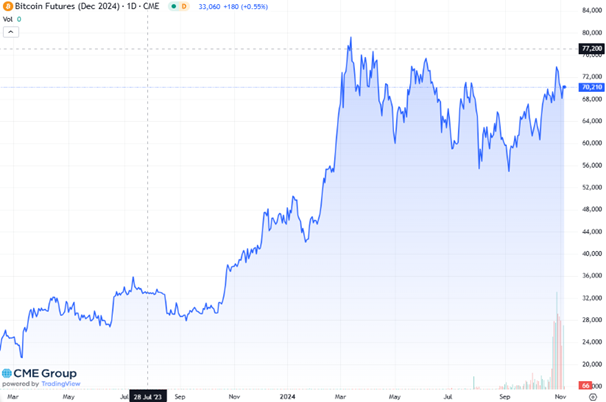
The latest analytical report of the Chicago Mercantile Exchange indicates increased interest from large investors in cryptocurrency derivatives. Institutional interest in Bitcoin and Ether remains high, as evidenced by the record number of owners of large open or buy positions, which was recorded throughout 2024. CME Group’s cryptocurrency futures averaged a record 480 institutional investors in the second quarter of 2024, up 9% from the previous record quarterly average in the first quarter of 2024. In addition, futures and options value averaged a record $13.7 billion in the second quarter of 2024.

4. Presentation

Доступність

Шрифти Шрифти

Розмір шрифта Розмір шрифта

1

Колір тексту Колір тексту

Колір тла Колір тла

Кернінг шрифтів Кернінг шрифтів

Видимість картинок Видимість картинок

Інтервал між літерами Інтервал між літерами

0

Висота рядка Висота рядка

1.2

Виділити посилання Виділити посилання

Text Alignment Text Alignment